


About Sol Ideas Technology Development
Biography of Greg Smestad, Ph.D.
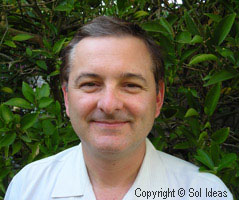
Greg P. Smestad received his Ph.D. in Physical Chemistry from the Swiss Federal Institute of Technology (EPFL) in 1994 on the topic of the thermodynamic limits of quantum solar energy conversion. He received his Masters degree in Materials Science and Engineering in 1985 from Stanford University, and his B. S. in Biology in 1983 from the University of Santa Clara in California. From 1995 to 2002, he was a part time professor in both the technical and policy fields. He currently works in the area of optoelectronics and materials used for solar energy conversion. He is the owner of this consulting firm, and has been instrumental in bringing to market several energy-related and educational products. He continues to develop, implement and analyze products that utilize advanced materials that lead to a cleaner and more sustainable environment.
From 1985 to 1990, Dr. Smestad was employed by the Hewlett-Packard Company, first as a Materials and Process Engineer (growing Czochralski, CZ, GaP), and later as an LED Optics Design Engineer. There he proposed, developed, and implemented novel LED optics based on non-imaging optics that are now used extensively in automotive and energy efficiency applications. From 1990 to 1992, he created and managed the optics and semiconductor characterization lab at the Hahn-Meitner Institute Solar Energy group in Berlin, Germany, and conducted research on novel thin film solar cells.
In 1992, he became part of the Solar Chemistry group of the Energy and Process Technology department at the Paul Scherrer Institute in Villigen, Switzerland, where he conducted his Ph.D. work. In 1994, he was employed by Lawrence Berkeley National Laboratory as an electrochemist and researcher developing thin film electrochromic (switchable) energy efficient windows.
From the Fall Quarter of 2013 through the Winter Quarter of 2016, he served as an Adjunct Lecturer at Santa Clara University in the graduate program of the School of Engineering. The course is Distributed and Renewable Energy for the Developing World. From 1995 to 2002, he was a professor, first as the founding lecture and lab chemist at the California State University, Monterey Bay, and then as a part time science-policy specialist at the Monterey Institute of International Studies. Greg P. Smestad, Ph.D. taught not only fundamental courses such as Environmental and General Chemistry, but created new courses such as Biopolicy and Energy and Environment relevant to global issues. Learn more about Dr. Smestad’s Teaching Experience and Credentials. From 1996 to 1999, he served as a consultant for Prof. M. Graetzel at the Swiss Federal Institute of Technology, and developed a novel Surlyn sealing technique for dye sensitized solar cells. From 1990 onward, he has served as Associate Editor for Solar Energy Materials and Solar Cells.
Dr. Smestad has also served as a conference chair and instructor at international conferences, authored over 15 scientific papers in technology, materials science, and energy policy, and has written a book on the Optoelectronics of Solar Cells. He invented, developed and brought to market an educational solar cell kit, Re-creating Photosynthesis, used by students and teachers world-wide. He holds three U.S. patents on LED optics, with a fourth on a sensor for a UV water purifier. He enjoys combining his interdisciplinary skills to solve practical problems in environmental science and policy, chemistry, engineering and renewable energy.
His skills include design, measurement and analysis of solar cells and photovoltaics, written and oral communication, project management, semiconductor materials characterization, optical design and analysis, spectroscopic, chemical and electrochemical measurements and analysis, sensor design (electronics and optics), energy policy analysis, grant writing, and professional instruction and education.
On a personal note, Dr. Smestad is an eighth generation Californian and a descendant of early Spanish settlers to Monterey and the San Francisco Bay Area, and he is involved in historical and educational activities related to his heritage.
- US 5,001,609 1991, “Non-Imaging Light Source” (light emitting diode, LED, chip optics).
- US 5,013,144 1991, “Light Source Having a Multiply Conic Lens” (LED lens optics).
- US 5,055,892 1991, “High Efficiency Lamp or Light Accepter” (LED non-imaging lens optics).
- US 6,429,438 2002, “Ultraviolet Light Detector for Liquid Disinfection Unit” (monitor for water sterilization/purification unit).
- US 7,291,782 2007, “Optoelectronic device and fabrication method” (nano-architected film for solar cell).
PATENTS:
AWARDS AND GRANTS:
2003-2005
National Park Service
Awardee for a Juan Bautista de Anza Trail Guide and Audio CD; Federal grant received from the National Park Service to write an educational trail guide and audio CD. http://www.nps.gov/juba/
10/1/99 – 4/1/01
University of California
Santa Cruz, California
California Energy Commission, Public Interest Research, PIER/EISG grant 99-10. Co-Principal Investigator, with Professor Jin Zhang, “Development and Characterization of Improved Solid State Dye-Sensitized Nanocrystalline Solar Cells.” Continued April – August 2001.
1998 – 1999
Radiation Monitoring Devices
Watertown, Massachusetts
Small Business Innovative Research Grant (SBIR), Phase I, “Screen-printed Solar Cells Based on Nanocrystalline TiO2 Films.” Solicitation No. DOE/ER-0706, 50533-98-I, 1998, Collaborator.
May 14, 1998
Georgia Institute of Technology
Atlanta, Georgia
Peter B. Sherry Memorial Lecture in Chemistry Award, Lecture: “Education, Chemistry and Electron Transfer: Demonstration of an Artificial Leaf.”
1995 – 1996
University of California
Santa Cruz, California
University of California Energy Institute, Energy Science and Technology program. Co-Principal Investigator, with Professor Jin Zhang, “Ultrafast studies of the charge injection mechanism in photosensitized TiO2 cells: A critical step towards efficient light energy conversion”.
Fiscal 1995
DOE/National Renewable Energy Lab
Golden, Colorado
Funded jointly by OER/BES, Div. Chemical Sciences, Div. Adv. Energy Projects, and EE/Office of Utility Technologies Photovoltaics Division. Served as collaborator, DOE/National Renewable Energy Lab Photochemical Solar Cells Subtask Ic, Cell Sealing.
THESIS:
G. Smestad, “Luminescence as a predictor of quantum solar energy conversion”, Thesis No. 1263 (1994), The Swiss Federal Institute of Technology (EPFL) Lausanne, Switzerland, thesis advisor: Prof. Dr. Michael Graetzel. DOI: 10.5075/epfl-thesis-1263
PUBLICATIONS:
Refer to Publications for a list of selected publications by Greg Smestad.
TALKS AND PRESENTATIONS:
- 2017 Dec 6 – Optical Characterization of PV Glass Coupons and PV Modules Related to Soiling Losses, Atlas/NIST Workshop on PV Materials Durability; G. Smestad – View Presentation.
- 2017 Jun 29 – Chemistry, materials science and technology related to photovoltaic, and photoelectrochemical solar energy conversion. Presented as part of the USPTO’s Patent Examiner Technical Training Program; G. Smestad – View Presentation on Slideshare.
- 2010 Jun 17 – A Systems Perspective for the Sustainable Deployment of Solar Energy presented at OIDA’s Green Photonics Forum: Innovation and Opportunity Lifecycle Impact of Solar Energy; G. Smestad – View Presentation.
- See Presentations for additional presentations by Greg Smestad.
ANZA TRAIL GUIDE:
MEMBERSHIPS
Please contact Dr. Smestad for an up to date list of current members and affiliations.
Dr. Smestad is currently available for consulting on a case-by-case basis. Fees are based on project parameters, time and materials. To inquire about our services and receive a preliminary price quote, please contact us.